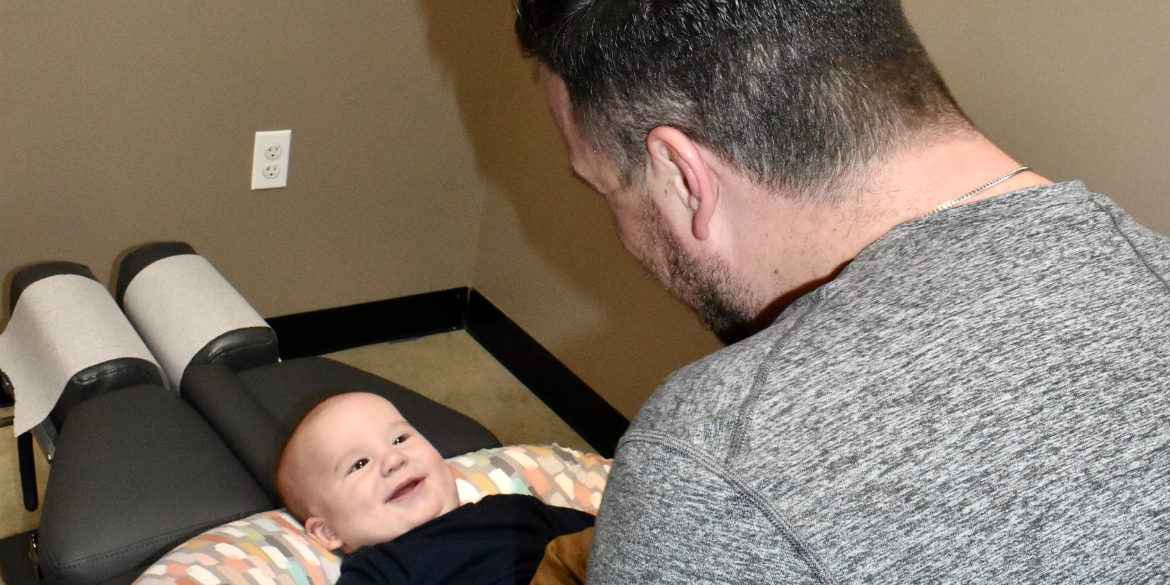
Just putting those words together can start a conversation.
Some parents are familiar with pediatric chiropractic care. For others, the reaction is immediate:
“You adjust babies?”
I understand the concern.
Most people think about chiropractic care based on what they have experienced as adults—or what they have seen in a video online. Maybe they have watched someone receive an adjustment and heard the popping sound, and they immediately picture someone doing the same thing to a tiny baby.
That is not how I want parents to think about pediatric chiropractic care.
As a chiropractor, but also as a father of three boys, I believe working with babies starts with something much more important than an adjustment:
Trust and Education
Parents deserve to understand what is being done, why it is being done, and whether it is appropriate for their child.
I Understand This Conversation as a Dad
This topic is personal for me because all three of my boys received chiropractic care from their earliest days.
One of my twins has struggled with chronic constipation, and chiropractic care has been one part of the care we have incorporated into his overall health.
But that is our family’s personal experience.
I would never take what happened with my child and tell every parent that the same thing will happen with theirs.
Every baby is different.
Every situation is different.
That’s exactly why parents deserve to understand what is happening before anyone begins caring for their child.
A Baby Is Not a Tiny Adult
An infant’s body is still developing.
When I work with a baby, I don’t approach that child the same way I would approach an adult walking into my office with back pain.
The entire visit should be different.
- The examination is different.
- The amount and type of force used are different.
- The way the baby is positioned and handled is different.
- Communication with Mom and Dad becomes an important part of the visit.
Before I do something, I want parents to understand what I am doing and why.
And I want them to ask questions.
In fact, I expect questions.
Parents should feel comfortable asking:
- What are you checking?
- Why are you touching that area?
- What are you hoping to learn?
- What are you looking for during the examination?
- What should I watch for at home?
- What are the potential benefits?
- What are the potential risks?
- When should I speak with my baby’s pediatrician?
Parents should never feel like they simply have to hand over their baby and trust that someone knows what they are doing.
This is your child. You have every right to understand.
Why Do Parents Bring Babies to a Chiropractor?
Parents may seek out a chiropractor for many different reasons.
Sometimes their baby seems uncomfortable or unusually fussy.
Sometimes feeding has been difficult.
Sometimes parents have concerns about:
- Gas or digestive discomfort
- Constipation
- Frequent spit-up
- Sleep
- Movement
- How comfortably the baby turns their head
- Positioning
- Concerns following a difficult delivery
These concerns are real—but they can also have many different causes.
That’s why I believe it is important not to automatically assume that every problem a baby experiences is a “chiropractic problem.”
If an infant has persistent symptoms, feeding difficulties, significant vomiting, poor growth, unusual or excessive crying, or another concern that worries the parents, appropriate pediatric evaluation is important.
Chiropractic care should never be used to delay or replace appropriate medical care when a baby needs it.
My responsibility isn’t simply to say:
“I can fix that.”
My responsibility is to ask:
“What is happening with this baby, and what is the appropriate next step?”
Sometimes that next step may include chiropractic care.
Sometimes it may involve the baby’s pediatrician or another healthcare professional.
Knowing the difference is part of responsible care.
Sometimes Helping the Baby Means Helping Mom and Dad
This may actually be one of my favorite parts of working with families.
I’m not the one getting up with that baby in the middle of the night.
Mom and Dad are.
They’re the ones feeding, changing, soothing, watching, and wondering:
- Is this normal?
- Why is my baby uncomfortable?
- Is there something I can do?
- Should I be concerned?
Parents already know many of the traditional things families have done for generations.
You may have heard about:
- Gently moving a baby’s legs in a bicycle motion
- Gently rubbing the baby’s tummy
- Different positions for holding and soothing
- Techniques for helping a baby become more comfortable
But sometimes what parents need most is simply someone who will slow down and listen.
Someone who will listen to what they are seeing at home, answer their questions, and help them better understand their baby’s body.
If I can show Mom and Dad appropriate techniques they can use at home, answer their questions, or help them recognize when a concern should be discussed with their pediatrician, that can be valuable too.
My goal is for parents to leave my office feeling more informed—not more dependent on me.
Parents Should Know What Their Baby’s Care Looks Like
Another reason this subject creates controversy is that people may see one dramatic chiropractic video online and assume all chiropractic care looks the same.
It doesn’t.
When infants are involved, care should be appropriate for the baby’s age, size, development, and individual circumstances.
Parents should know exactly what type of care is being proposed before consenting.
Ask the practitioner:
What training do you have working with infants?
How much experience do you have caring for babies?
What exactly are you doing?
Why are you recommending it?
What are the potential benefits?
What are the potential risks?
And if something doesn’t feel right to you as a parent, ask more questions.
I don’t consider those questions disrespectful.
I consider them responsible parenting.
What Does the Research Tell Us?
This is where I think we have to be especially careful.
Parents sometimes hear claims that chiropractic care can treat infant colic, constipation, reflux, latching difficulties, and other childhood conditions.
Some families report positive experiences. But a parent’s experience is not the same thing as scientific evidence.
Research regarding spinal manipulation and mobilization in infants and children remains limited, and available evidence does not establish chiropractic care as an effective treatment for a broad range of pediatric conditions.
The National Center for Complementary and Integrative Health (NCCIH) also emphasizes that evidence for many complementary approaches in children is limited and that complementary approaches should not replace or delay appropriate conventional medical care.
That doesn’t mean parents shouldn’t ask questions or have a conversation with a chiropractor.
It means that conversation should be an informed one.
Parents deserve to understand what is known, what is uncertain, and what other options may be appropriate.
There Is Nothing More Important Than Your Baby
Parents want the best for their children.
Mothers spend months carrying and protecting their babies before they are even born. Then that little person arrives, and suddenly every sound, every movement, and every expression matters.
You don’t want someone unnecessarily poking or prodding your baby.
You don’t want your baby uncomfortable.
And you certainly don’t want someone dismissing your concerns.
I understand that.
That’s why I believe the first step in pediatric care isn’t the adjustment.
It’s the Conversation.
Tell me what you’re seeing.
Tell me what you’re worried about.
Let me explain what I’m looking at.
Let’s determine whether this is something that may be appropriate for chiropractic care—or whether another healthcare professional should be involved.
And if we do decide to proceed, you should understand exactly what we’re doing and why.
My Goal Is to Empower the Parent
When I think about caring for babies, I don’t just think about the few minutes a child may spend in my office.
I think about the other 23 hours and 50-something minutes of the day.
That baby is going home with Mom and Dad.
So if I can teach those parents something that helps them better understand their child, feel more confident asking questions, or recognize when something deserves additional attention, I have done something important.
Because ultimately, pediatric healthcare should never be about convincing a parent that one profession has all the answers.
It should be about helping parents make informed decisions for the little person who depends on them for everything.
And whether you ultimately choose chiropractic care for your baby or not, you deserve answers before you decide.
Have Questions About Chiropractic Care for Your Baby?
If you have questions about pediatric chiropractic care and want to understand what an infant evaluation looks like, schedule a consultation.
Bring your questions.
We can talk about:
- What you’re seeing at home
- Your baby’s history and development
- What an infant evaluation involves
- What may warrant additional medical evaluation
- Whether chiropractic care is an appropriate option for your child
No pressure. No assumptions. Just a conversation about your baby’s health and your concerns as a parent.
Your baby deserves thoughtful care.
You deserve to understand it.